High Water Bill Leak Detection
Find out why a bill jumped or the meter will not stop, and whether a leak is the cause.
A bill that jumps for no clear reason is stressful. In most cases the water went somewhere you did not notice. The list below goes from the cheapest cause to find to the hardest.
By the Avondale Plumbing Co. team ·
Start by comparing the same month last year. Summer in the Valley raises use for irrigation, pools and cooling. A higher bill in July may be normal, while the same jump in November is not.
Look at the usage figure, not only the dollar amount. Rates and fees change, but gallons tell you whether more water actually passed through the meter.
A toilet with a worn flapper can leak many gallons a day without a sound. Put dye in the tank and wait. If color reaches the bowl without a flush, replace the flapper.
Check every toilet in the house. The guest bathroom that nobody uses is a common offender.
A broken sprinkler head, a cracked pipe or a valve stuck open can run for hours. Check the controller for odd run times and walk the yard while a zone runs.
If you changed your watering schedule recently, compare it to the bill. Landscaping that was just installed also drinks heavily until it settles.
A pool loses water to evaporation, and an autofill valve quietly refills it. If the valve sticks or the pool has a leak, the bill climbs. A bucket test helps tell the two apart.
Read pool leak detection if the level keeps dropping.
A faucet that drips once per second can waste thousands of gallons over a year. Outdoor spigots that drip into a planter may go unseen.
Both are quick, inexpensive fixes. Check them before you suspect something larger.
A slow leak at a tank fitting, a washer hose or a dishwasher line may drip into a closet or a drain pan. The relief valve discharge pipe can also run if the valve is failing.
Look at the garage heater, which is often forgotten.
Pick the row that fits your situation and start with the check shown.
| Cause | Clue | First check |
|---|---|---|
| Toilet flapper | A quiet, constant loss | Dye in the tank |
| Irrigation | A valve stuck open, a cracked sprinkler head or a long schedule | Review the controller, then watch the yard while it runs |
| Pool autofill | The pool keeps dropping and refilling | Bucket test with the autofill off |
| Dripping fixtures | A drip at a faucet or hose bib | Look and listen at each fixture |
| Hidden leak | Stains, damp spots or a meter that moves with all off | Meter test, then leak detection |
If the meter spins with every fixture off, the leak is in a pipe you cannot see. A buried line between the meter and the house is a common location, and so is a slab line.
This is where high water bill leak detection helps. A plumber confirms the leak, pinpoints it and explains the repair choices.
Most bills list usage in gallons or in hundred cubic feet. One hundred cubic feet is about 748 gallons. Knowing the unit helps you compare months and spot a jump that the dollar figure hides.
Write the usage for the last six months in a list. Mark any month with unusual events, such as guests, a pool fill or new sod. A month that stands out with no reason is the one to investigate.
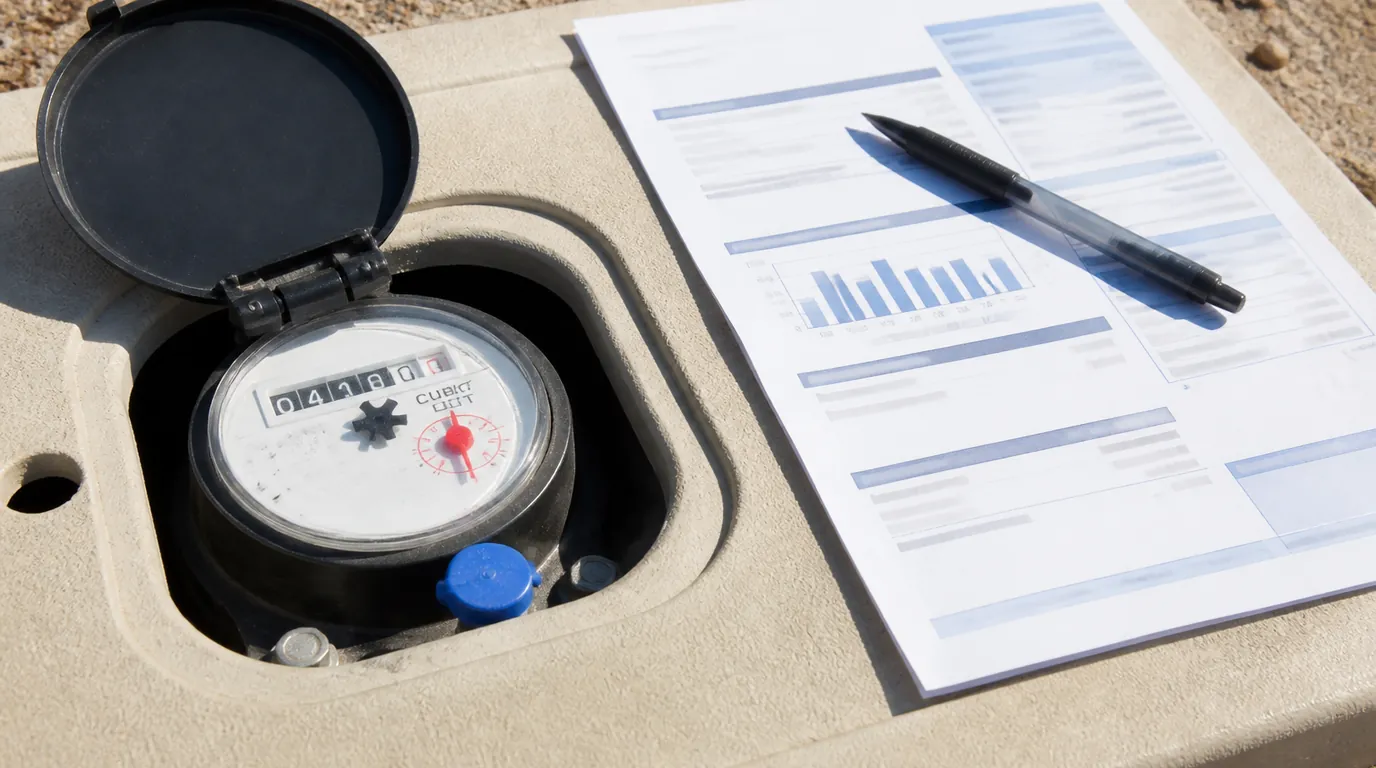
Shut off every fixture and write down the meter reading. Use no water for two hours, then read it again. A different number means water moved. A change of a single digit on the sweep hand is enough to prove a leak.
If the number did not move, the leak may be intermittent. Irrigation timers, softener regeneration and ice makers can use water at set times. Check the schedules and repeat the test overnight.
Arizona summers raise water use. Landscaping needs more, evaporative coolers draw water, pools lose more to evaporation and people shower more often. A bill that is higher in July than in January is expected.
What is not expected is a bill that stays high in cooler months or that jumps beyond the seasonal pattern. That is when to check for a leak.
A plumber confirms the leak with a pressure test, isolates the section and uses listening gear or a thermal camera to find it. The result is a location, a cause and a repair choice, not a guess.
Ask for a written explanation. If the leak was on your side of the meter, your utility may have an adjustment process, and a plumber's report helps.
Guests, a new baby, a new pool or a remote worker at home all raise use. If nothing leaks, the bill may simply reflect life at home.
Check the usage trend over several months before you decide there is a problem.
Meters can fail, but leaks are far more common. Do the meter test with every fixture off before asking the utility to test it.
Call your water provider. For City of Avondale accounts, Public Works can be reached at (623) 333-4400.
Yes. A leak in a buried line or under a slab may show nothing on the surface.
Some utilities offer adjustments. Ask your provider about its policy after the leak is fixed.
The cause may be use, not a leak. Review irrigation, a pool, guests and seasonal habits.
A softener uses water when it regenerates. A stuck valve can run constantly, so check it if you have one.
Find out why a bill jumped or the meter will not stop, and whether a leak is the cause.
Pinpoint where hidden water is escaping, whether in a wall, under a floor or along the buried pipe, before any demolition starts.
Repair or replace the underground line that feeds water into the house.
With a meter, some dye tablets and a slow walk through each room, you can shrink a hidden leak to one zone before phoning a plumber.
Hissing or random refilling means water is draining away all day. Most cases trace back to the flapper or the fill valve.
Evaporation or a leak? A bucket on the pool step and a marker give you a fair answer in a day.
Call and say what the meter test showed. A dispatcher will match you with a local plumber.
Service area centered on Avondale and nearby Maricopa County cities.