Water Softener Installation & Repair
Fit a softener to tame hard water, or revive one that has stopped regenerating.
Hard water is part of life in the Valley. The white crust on a faucet is only the visible part. Inside the pipes and the water heater, the same minerals build up quietly and shorten the life of equipment.
By the Avondale Plumbing Co. team ·
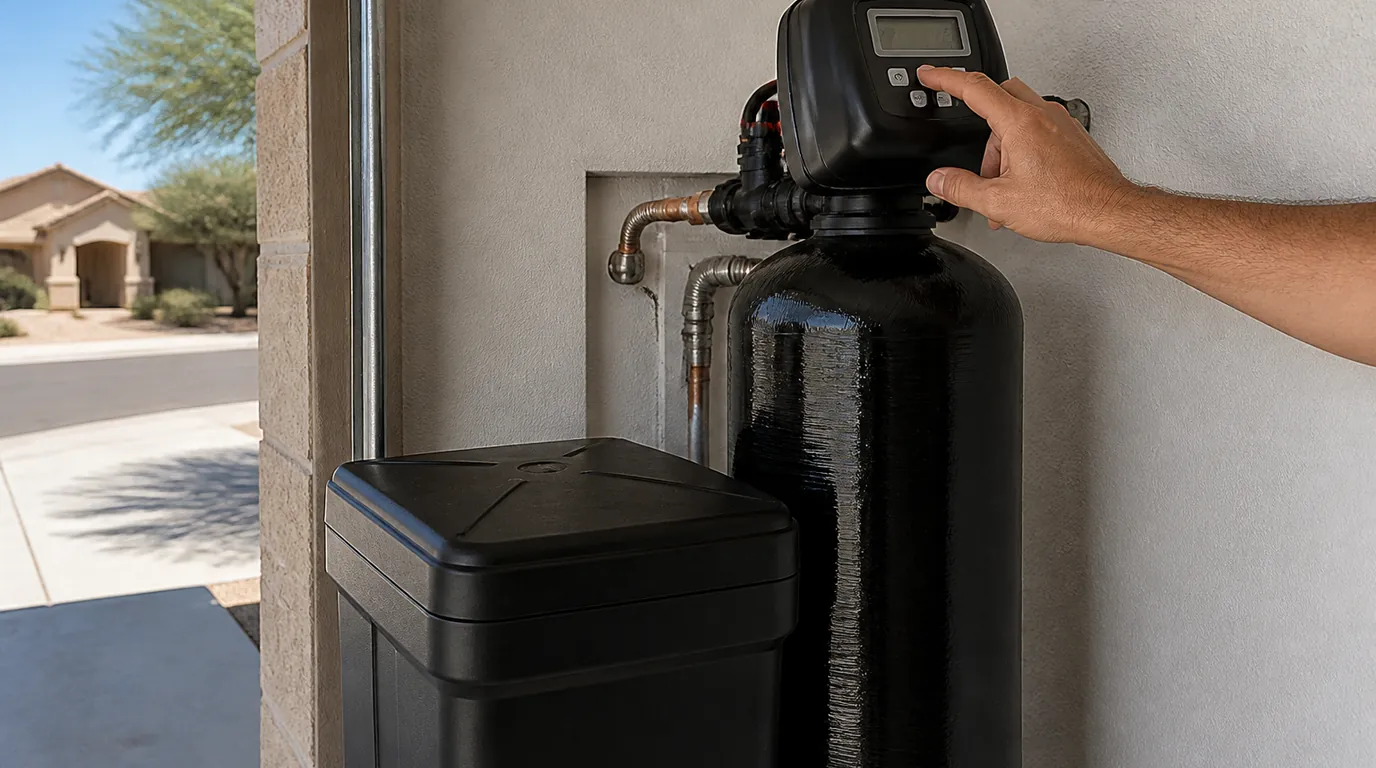
Hard water carries dissolved calcium and magnesium. When the water evaporates or heats, those minerals fall out as scale. Hardness is measured in grains per gallon.
One third-party estimate for ZIP 85323 puts Avondale at about 14 grains per gallon, which is considered very hard. Your own test gives the best number for your home.
The City of Avondale's supply blends groundwater from city wells, Colorado River water delivered through Phoenix and surface water. Each source carries minerals, so hardness can shift a little over time.
The city publishes an annual water quality report. It lists what the water contains, and it is a good place to start.
White or gray crust on faucets and showerheads, spots on glass, stiff laundry and soap that does not lather are the visible signs. A kettle with a chalky layer inside is another.
Scale also narrows small openings, so aerators clog and showerheads lose spray.
In a water heater, scale coats the bottom of the tank and the elements. It acts like insulation, so the heater works harder, makes noise and wears out sooner.
In tankless units, scale can block the heat exchanger. Pipes also narrow over time, and valves and cartridges stick.
Scale affects different parts of the house in different ways.
| Where | What you see | What helps |
|---|---|---|
| Faucets and showerheads | White crust and weak spray | Vinegar soak |
| Water heater tank | Noise and slow recovery | Flush and anode check |
| Tankless unit | Error codes and low flow | Descale on schedule |
| Whole house | Spots, stiff laundry, short fixture life | A water softener |
Soak aerators and showerheads in white vinegar for an hour, then scrub gently. Wipe faucets with a vinegar cloth, and rinse. Avoid acid on natural stone.
Squeegee shower glass after use. It takes seconds, and it prevents the film from building.
Draining some water from the bottom of a tank water heater clears sediment. Do it with the power or gas off and the cold supply closed. Ask a plumber about the anode rod, which protects the tank.
For a tankless unit, follow the maker's descaling schedule. Read tankless water heater service for details.
A water softener removes hardness and prevents most scale. It uses salt or potassium and a drain, and it needs service from time to time. A filter does not soften water.
Read water softener installation and repair and water filtration to compare.
Each heating cycle in a water heater drops a thin layer of minerals. Over years, the layers thicken into a hard crust that insulates the heating surface. The heater then needs more energy to deliver the same hot water.
Showerheads, aerators and valves narrow in the same slow way. Because the change is gradual, many households only notice it after a fixture fails.
Dishwashers, washing machines, ice makers and coffee makers all see mineral buildup. Spots on dishes and stiff towels are early signs, and heating elements wear out faster in hard water.
Descaling appliances on the maker's schedule helps. A softener at the main line protects them all at once.
A simple test strip or a lab test shows your hardness. Share the number with any company that quotes a softener, so the system is sized to the actual water and not to a guess.
Ask about salt use, drain requirements and any local rules for discharge. Some communities and associations set limits.
A softener reduces scale but does not remove every mineral. Some people like the feel of softened water, and others find it slick. A softener also needs salt and periodic checks.
Pair it with regular heater flushing for best results, and clean fixtures with vinegar as needed.
Once a month, wipe faucets and showerheads with a vinegar cloth, run a cup of vinegar through the coffee maker and check the aerators. Squeegee the glass after showers. These tasks take a few minutes and keep scale from taking hold.
Twice a year, check the water heater for noise, damp spots or slow recovery. Early signs are easy to fix. Late signs often mean replacement.
A rumbling tank, slower recovery and hot water that runs out earlier than before all point to sediment. Rust-colored water from the hot side can also mean the tank is wearing out.
If the unit is older than ten years, flushing may not be enough. Ask a plumber to read the label and estimate how much life is left before you spend money on repairs.
Call if hot water runs weak, the heater is noisy or fixtures clog again soon after cleaning. A plumber can check the heater, measure hardness and suggest a plan.
See water heater repair if the tank is already failing.
Hardness itself is generally not a health concern. It is mainly a nuisance for fixtures and equipment.
Short soaks of fixtures are fine. Do not pour strong acid into pipes.
A test strip gives a rough number. A lab test is more precise.
It uses some during regeneration. Modern units are more efficient.
No. A filter handles that.
A test strip gives a fast estimate and a lab test a precise one. The yearly quality report from your water provider also lists what is in the supply.
Fit a softener to tame hard water, or revive one that has stopped regenerating.
Work out why a tank leaks, rumbles, runs lukewarm or loses its pilot flame.
Descale an on-demand heater, diagnose an error code or install a new unit.
Moisture at the bottom of a tank may come from a fitting, a valve or the tank body. Here is how to tell them apart and what to turn off first.
Weak showers can come from one clogged aerator or from a failing main line. Narrow it down by checking where the weakness shows up.
A dead handle, a weak swirl or a bowl that fills and stalls each point to a different cause. Match the symptom to the fix.
Call and ask about testing and options. The dispatcher will take it from there.
Service area centered on Avondale and nearby Maricopa County cities.