Low Water Pressure Repair
Find out why showers and taps have gone weak, from a scaled aerator to a worn regulator.
Weak flow at one tap and weak flow everywhere are different problems. Where the weakness shows up is the first clue, and a few quick checks can save a service call.
By the Avondale Plumbing Co. team ·
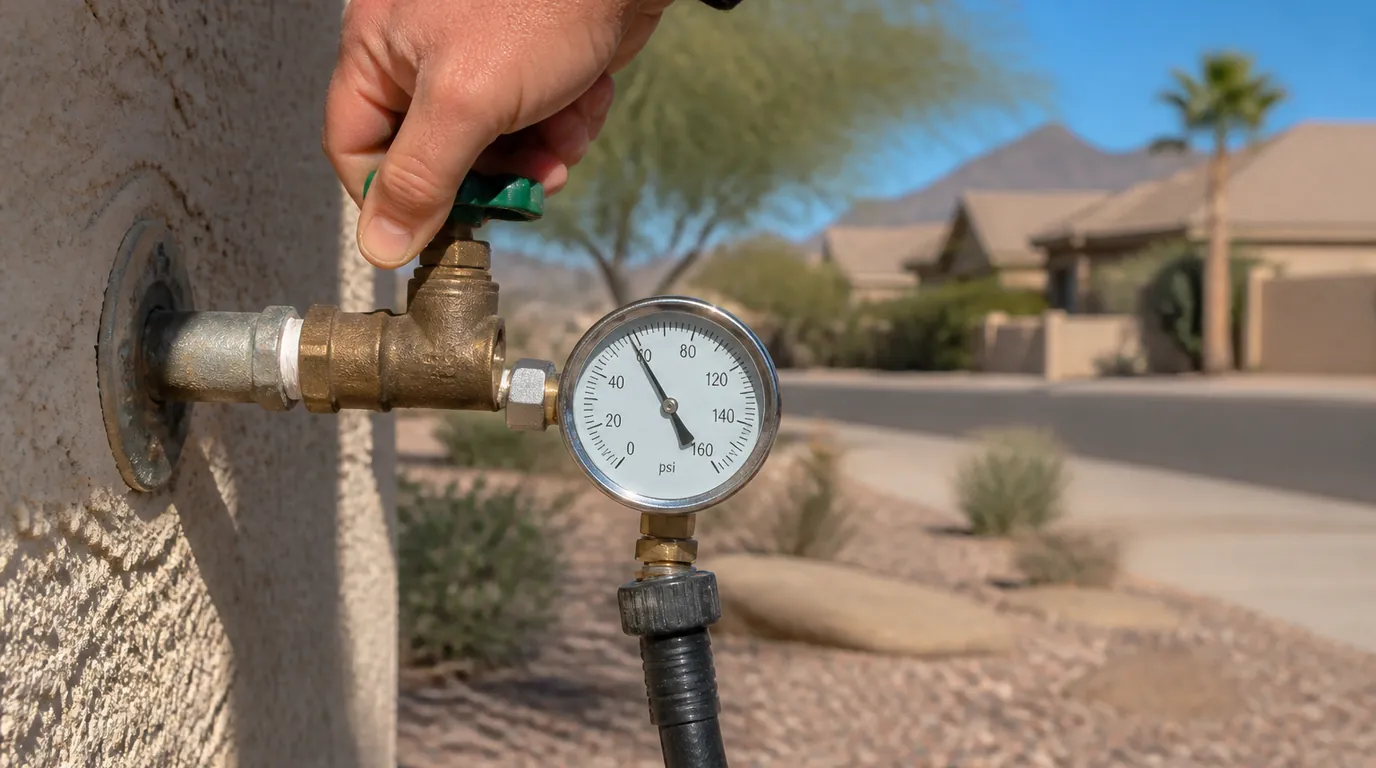
Weakness at a single faucet usually blames that fixture. Weakness at every tap shifts attention to the shutoff valves, the regulator and the supply pipe.
If hot water is weak but cold is fine, the water heater or its valves may be the cause.
Hard water leaves mineral deposits that clog small openings. Unscrew the aerator or showerhead and look for white crust.
Soaking the part in vinegar often restores flow. A softener reduces the buildup in the first place.
The main shutoff and the meter valve can be partly closed after a repair. A stop valve under a sink may be only half open.
Open each fully and see if flow improves. Do it gently, since old valves can leak when moved.
Many houses have a regulator near the main, and a worn one lets pressure sag or swing. Threading a gauge onto a hose bib shows the true figure.
A plumber can test and replace the regulator. Do not adjust it without a gauge.
The pattern of weak flow points to the likely cause.
| Pattern | Likely cause | First check |
|---|---|---|
| One faucet only | A clogged aerator or cartridge | Unscrew the aerator and look for scale |
| Hot side only | The water heater or a hot valve | Check heater valves |
| Whole house | A partly closed valve or a failing regulator | Open valves, then read a gauge |
| Sudden drop with rusty water | Corroded pipe or a leak | Meter test and plumber visit |
Older galvanized pipe rusts from the inside and narrows over time. Flow drops, and rusty water may appear. Repiping solves it for good.
Read repiping if the whole house is affected.
A leak in the main line or the house can reduce pressure at the tap. If the meter spins with everything off, a leak is likely.
See leak detection for how a plumber finds it.
A simple gauge screws onto a hose bib and costs little. Close other taps, open the bib and read the dial. Many homes see a number in the range of 40 to 80 psi.
If the reading is under 40, flow will feel weak. If it is much higher than 80, fixtures wear fast. Either reading gives a plumber something concrete to work with.
Pressure is the push. Flow is how much water arrives. A clogged pipe can have good pressure at the meter and poor flow at the tap. A gauge with the tap closed shows pressure, and a bucket test shows flow.
Run a tap into a bucket for ten seconds and measure. Compare with another tap. A difference points to a local blockage.
Pressure can dip when many neighbors water lawns in the evening. A short dip in peak hours is common. A drop that lasts all day is not.
If a neighbor has the same issue, call the utility. If only your house is weak, look at your own regulator, valves and pipe.
If cold water is strong but hot is weak, look at the heater. A partly closed valve, sediment in the tank or a clogged outlet can restrict flow. A failing mixing valve in a shower can also reduce hot flow.
A plumber can isolate the hot side and test.
Start with aerators and showerheads, then valves, then the regulator, then the pipe. Each step is more work and more cost. Do the cheap ones first.
If the cause is old pipe, plan a larger job. Read water line repair and replacement if the line from the meter is the issue.
If pressure drops in the evening when neighbors water lawns, the cause is shared demand and not your plumbing. A dip that lasts an hour or two is usually a neighborhood pattern.
Note the time of day and the days of the week. If the pattern is steady, mention it to the water provider along with your address.
Filters, softeners and strainers can clog and restrict flow. A whole house filter that has gone too long without a cartridge change is a common cause of whole house weakness.
Check the pressure gauge before and after the filter if the system has one. A big difference means it is time for service.
Share where the pressure is low, when it began, what you checked and what the gauge read. Note any recent construction at the house or on the street. Details like these shorten the visit.
If you have photographs of the meter box, the regulator or the main valve, bring them up too. Clear information leads to a faster fix.
Call if pressure dropped suddenly, if hot and cold are both weak or if you see rusty water. Describe where it is weak and when it began.
A visit that starts with a gauge reading gives you real numbers. See low water pressure repair for the full picture.
Scale in that tap's aerator or a clogged cartridge is the most common reason.
Yes. Scale narrows pipes and clogs small openings.
Residential pressure is commonly in the range of 40 to 80 psi. A gauge on a hose bib shows yours.
Utility work can briefly change pressure. If it lasts, test at your hose bib.
Adjusting a regulator without a gauge can harm fixtures. Use a gauge or call a plumber.
A valve may be partly closed or debris may have clogged an aerator.
Find out why showers and taps have gone weak, from a scaled aerator to a worn regulator.
Swap out worn supply piping across the house once patching no longer holds.
Pinpoint where hidden water is escaping, whether in a wall, under a floor or along the buried pipe, before any demolition starts.
A bang in the walls when a tap shuts is water hammer. The cause is often pressure or a loose pipe, and the fixes are simple.
Both work for repiping. Learn how they differ in cost, install, heat, water chemistry and repair.
White crust on faucets and short-lived heaters are signs of hard water. Learn what scale does and how to deal with it.
Call and say where the pressure is weak. A dispatcher will find the right plumber for the job.
Service area centered on Avondale and nearby Maricopa County cities.