Repiping & Whole-Home Pipe Replacement
Swap out worn supply piping across the house once patching no longer holds.
When a house needs new supply lines, the choice often comes down to PEX or copper. Building codes allow both, and either can serve for many years. Your house, your water and your budget decide which is better.
By the Avondale Plumbing Co. team ·
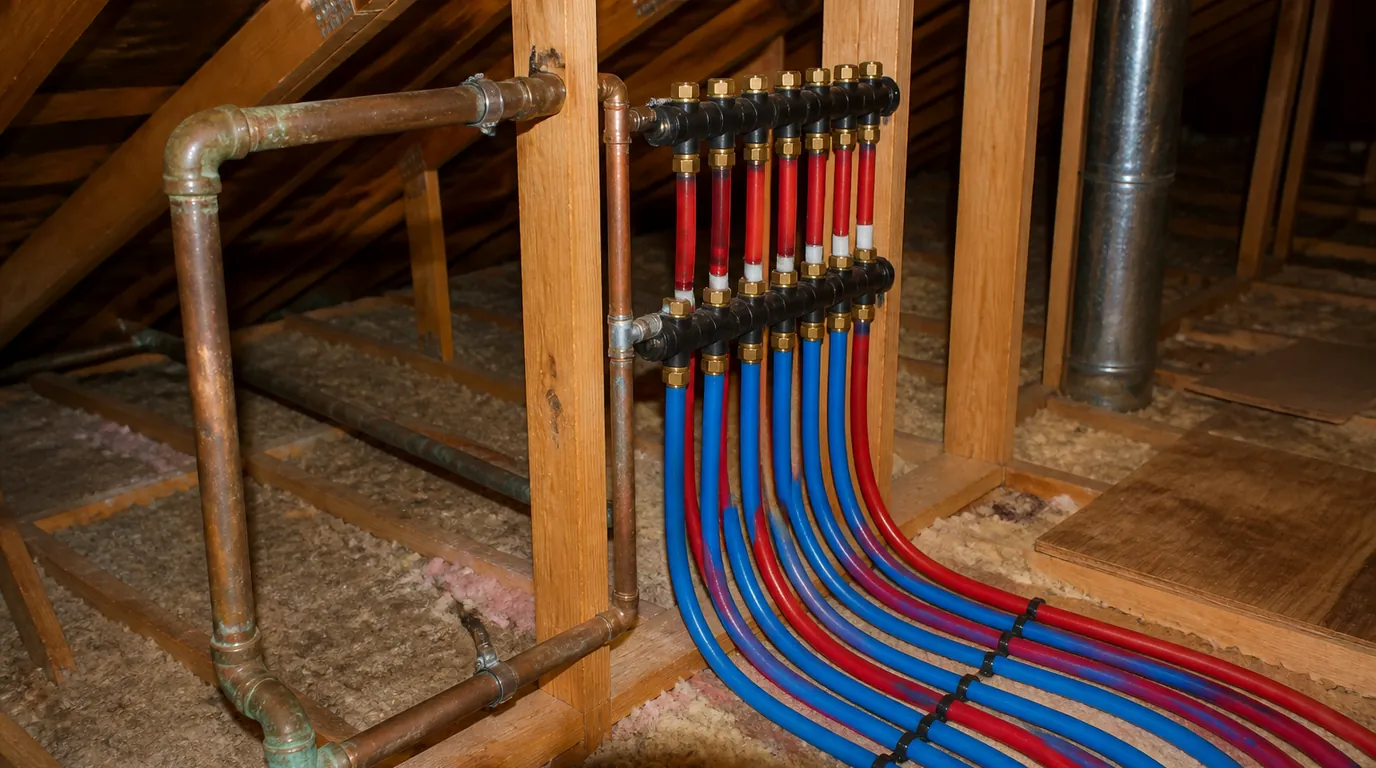
PEX is a flexible plastic tube made from cross-linked polyethylene. It comes in coils and uses fittings that are crimped or expanded. Copper is rigid metal tube joined by soldering or press fittings.
Both carry hot and cold water. Which one suits your house depends on what you value.
PEX curves around obstacles and comes in long coils, which means fewer joints and smaller openings in the walls. That often means less drywall repair and a shorter job.
Copper needs more fittings and more cutting. It takes more time, and a house with finished walls can mean more patching.
PEX material costs less than copper, and the job usually goes faster. Copper prices move with the metal market, and soldering takes skill and time.
Ask each bidder for a line-by-line quote. Include drywall and paint, which can make up a large share of a repipe.
Arizona sun can harm PEX if it sits exposed. Plastic degrades under ultraviolet light, so exposed runs need protection and should not sit outside for long before covering.
Copper handles heat and sun without a problem. Inside walls and attics, PEX runs are protected from light.
A quick view of the main differences.
| Topic | PEX | Copper |
|---|---|---|
| Installation | Flexible, fewer joints, less wall opening | Rigid, more joints, more cutting |
| Cost | Usually lower in material and labor | Usually higher |
| Sun exposure | Must be protected from sunlight | Handles sun well |
| Hard or aggressive water | Does not corrode | Can scale or pit over time |
| Repairs | Couplings are quick | Soldering or press tools |
Hard water scales inside copper over time, and aggressive water can cause pinhole leaks in copper. PEX does not corrode, though scale still forms in fittings.
Ask the plumber about your water and what they have seen in similar homes.
PEX can be repaired with a coupling, and it resists bursting from a freeze better than rigid pipe. Copper repairs need soldering or a press tool.
Both can last for decades when installed well. Fittings and installation quality matter as much as the material.
Many homeowners choose PEX for cost, speed and flexibility. Some prefer copper for its long record and its resistance to sun and pests. Local code and insurer preferences also matter.
Read repiping and whole-home pipe replacement for how the job works.
A repipe replaces the supply lines that carry water to fixtures. A plumber shuts off the water, opens small access holes in walls and runs new pipe from a manifold or main line to each fixture.
Most jobs take a few days. The crew patches the holes and tests the system under pressure before you turn the taps back on.
Joints are where leaks start, so how a material connects matters. PEX uses crimp or expansion rings, and good installers test each joint. Copper uses solder or press fittings that need clean, well-prepared surfaces.
Ask what fitting system the installer uses and whether the manufacturer's warranty requires specific parts.
Copper can tick as it heats and cools, and it can carry vibration from a pump or a washing machine. PEX is quieter and stays warmer in transit, though neither is a big difference for most households.
If a bedroom wall holds a line, mention it to the installer so the pipe is cushioned and well secured.
Ask who pulls the permit, how walls will be restored and whether the quote includes fixtures' shutoff valves. Ask how long the warranty runs on labor and on materials, and what voids it.
Compare the written scope, not only the price. A lower bid that skips patching may cost more in the end.
Pipe manufacturers publish warranties that depend on correct installation, approved fittings and protection from sunlight and chemicals. Keep the paperwork from the installer, and take photos of the manifold and the main runs before the walls close.
Local code decides which materials are allowed and how the work is inspected. Ask the installer to confirm the permit and the inspection date. A passed inspection is your record that the work met the rules, and it helps when you sell the house.
Not every house needs a full repipe. If leaks are rare, pressure is steady and the water is clear, repairing a single section may make sense. A plumber can test the pipe and tell you how much life it likely has.
Repiping becomes more attractive after the third or fourth leak in a short time, after rusty water appears or when walls are already open for a remodel. Ask for a repair price and a repipe price so you can compare them side by side.
Ask what fittings will be used, how long the warranty runs and how walls will be repaired. Ask whether the installer is experienced with the material.
If you are building or remodeling, see new construction plumbing.
PEX is approved for potable water. Check that the product carries the right certification.
Both can last decades. Water quality and installation matter.
Yes, with proper transition fittings.
Pests can damage many materials. Ask about protection in attics.
PEX tends to be quieter. Straps and cushioning matter for both.
Buyers and inspectors generally accept both materials when the work is permitted and well installed. Keep the permit and warranty paperwork with your house records.
Swap out worn supply piping across the house once patching no longer holds.
Underground, rough-in and trim plumbing for new builds, additions and remodels.
Repair or replace the underground line that feeds water into the house.
Weak showers can come from one clogged aerator or from a failing main line. Narrow it down by checking where the weakness shows up.
A bang in the walls when a tap shuts is water hammer. The cause is often pressure or a loose pipe, and the fixes are simple.
Know where the shutoff is before a pipe bursts. Learn the two valves, which way to turn them and how to test that they hold.
Call and ask for a written comparison of both materials. Someone will connect you with a plumber right away.
Service area centered on Avondale and nearby Maricopa County cities.