Burst Pipe Repair
Shut down a split pipe quickly, then repair or replace the damaged section.
When a pipe bursts, seconds count. The main shutoff stops water to the whole house, and every household member should know where it is. Finding it and testing it now is far easier than doing it in a panic.
By the Avondale Plumbing Co. team ·
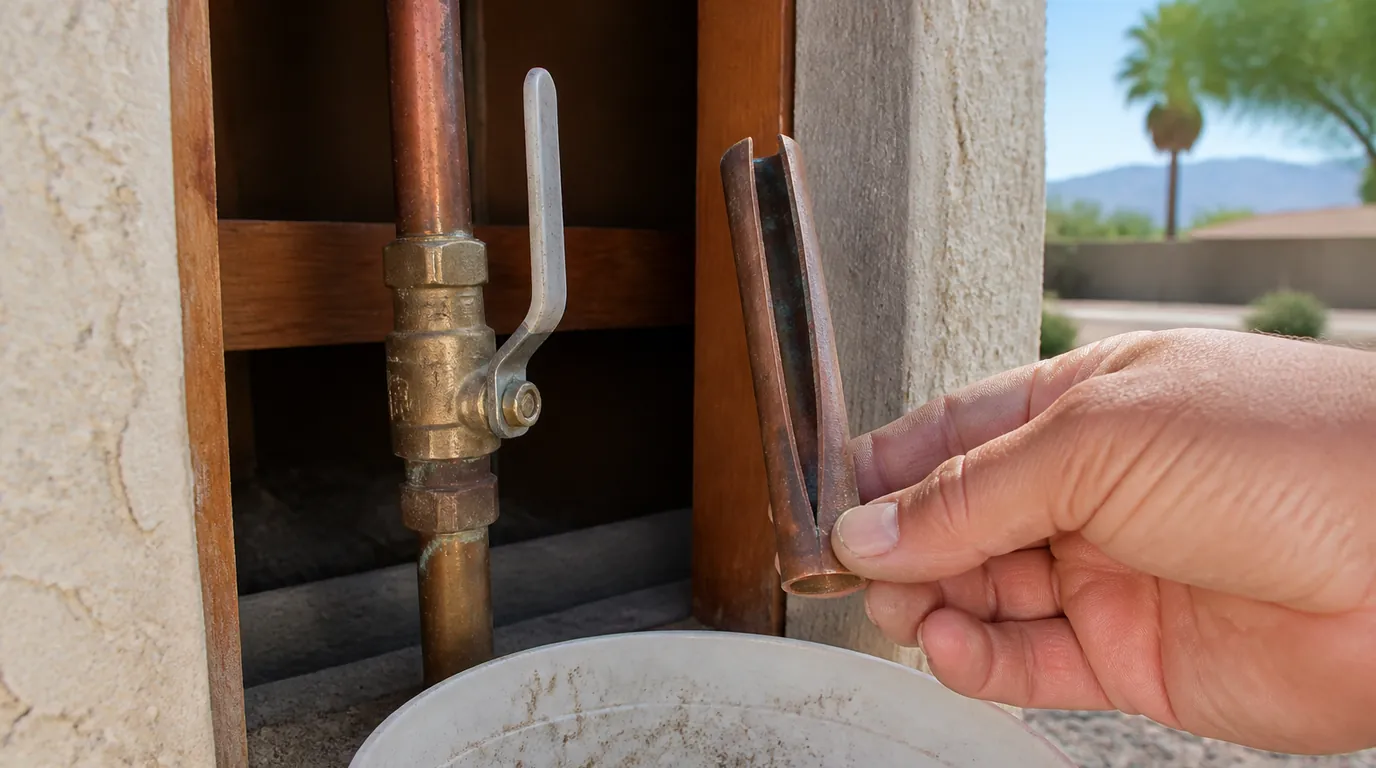
Most houses have two shutoffs. One sits at the meter, in a box near the curb, and belongs to the utility. The other sits where the line enters the house, and it belongs to you.
The house valve is the one to use in an emergency. The meter valve is a backup, and in some places only the utility should operate it.
In the Valley, the house valve is often on an exterior wall near the front or side, close to the hose bib, or in the garage. It can also sit in a utility closet or near the water heater.
Follow the main line from the meter toward the house. The valve is usually within a few feet of where the pipe turns up or enters the wall. A shutoff may also hide behind a small access panel.
A gate valve has a round wheel handle and closes after several full turns clockwise. A ball valve has a lever and needs only a quarter turn. The lever sits across the pipe when the valve is closed.
Old gate valves can stick or leak around the stem. Do not force one. If it will not move, call a plumber.
Close the valve and open a tap on the lowest floor. The flow should stop within a minute. Then open a tap on the highest floor. If water keeps running, the valve is not fully closed.
Test it at least once a year. A valve that never moves can seize. Moving it gently keeps it free.
Knowing your valve saves time in an emergency.
| Valve | Handle | To close |
|---|---|---|
| Gate valve | A round wheel | Turn clockwise until it stops |
| Ball valve | A lever | Turn so the lever is across the pipe |
| Meter valve | A small flat tab or lever | Use the house valve first |
| Fixture stop | A small oval or round handle | Turn clockwise |
Every toilet and sink should have its own small shutoff. They are the fast answer to a single leak, and they keep the rest of the house running. Turn them clockwise to close.
Test them too. Valves that have not moved in years may drip when disturbed, so test with a towel ready.
Open the lowest tap to let the pipes empty. Switch off the water heater as well, since a tank that runs dry can burn out its element. Take photos of any damage for your insurer.
Then call a plumber. If water already soaked floors or drywall, ask about water damage restoration.
Tie a bright tag to the valve and take a photo of its location. Show everyone in the house, including teenagers and anyone who house-sits.
Keep a wrench and a flashlight near it if the valve needs a tool.
Do a short drill. Show each adult where the valve is, close it and open a tap to confirm the flow stops. Then open the valve again slowly and let air escape from a tap before you close it.
A drill takes five minutes and turns a stressful moment into a familiar task.
After a repair, open the main valve slowly. Open a tap at the highest point to let air escape, then close it once water runs steadily. Check under sinks and around fixtures for drips.
Water heaters need the tank to refill before the power or gas goes back on. An electric element that fires dry can burn out within minutes.
A valve that weeps around the stem, a wheel that spins freely or a lever that feels loose needs attention. These are signs the internals have failed, and the valve may not hold in an emergency.
A new main valve requires the water to be cut off at the meter, which is why a plumber normally does the swap. A full-port ball valve is a good thing to ask about.
Do not force a stuck valve or lean on a pipe wrench against a handle that is not meant for it. A broken stem can turn a minor leak into a major one. If the house valve fails, use the meter valve only if you know how, or call the utility.
In an emergency, open the lowest tap to relieve pressure, shut off the water heater and call a plumber. A stuck valve is a sign that it should be replaced soon.
Write down the location of the main valve, the water heater shutoff and the plumber's number, and post them near the electrical panel. Add your insurer's claim line.
Photograph the meter box and the valve with a date, and store the photos on your phone. In a stressful moment, a picture tells a helper exactly where to go.
A valve that is stuck, leaking or hard to reach is worth replacing. A ball valve is faster and more reliable than an old gate valve. A plumber can swap it in a short visit.
Read burst pipe repair for what happens next after a break.
Clockwise closes a wheel valve. A lever across the pipe means closed.
Look near the hose bib, the garage and the water heater. A plumber can locate it.
Use the house valve first. The meter valve may be reserved for the utility.
Pipes drain. If it keeps running, the valve may not be fully closed.
Yes, once a year, gently.
Shut down a split pipe quickly, then repair or replace the damaged section.
Dry and rebuild floors and walls after a leak, a burst pipe or flooding.
Pinpoint where hidden water is escaping, whether in a wall, under a floor or along the buried pipe, before any demolition starts.
With a meter, some dye tablets and a slow walk through each room, you can shrink a hidden leak to one zone before phoning a plumber.
Moisture at the bottom of a tank may come from a fitting, a valve or the tank body. Here is how to tell them apart and what to turn off first.
A drip at the handle or water behind the wall from a hose bib can waste water and damage the house. Learn the simple fixes.
Call the 24/7 line now. You will be put through to a plumber who can help.
Service area centered on Avondale and nearby Maricopa County cities.