Water Heater Repair
Work out why a tank leaks, rumbles, runs lukewarm or loses its pilot flame.
Water on the floor around a tank is a reason to act, not to wait. Some sources are simple fixes. Others mean the tank has reached the end of its life. Either way, the first steps are the same.
By the Avondale Plumbing Co. team ·
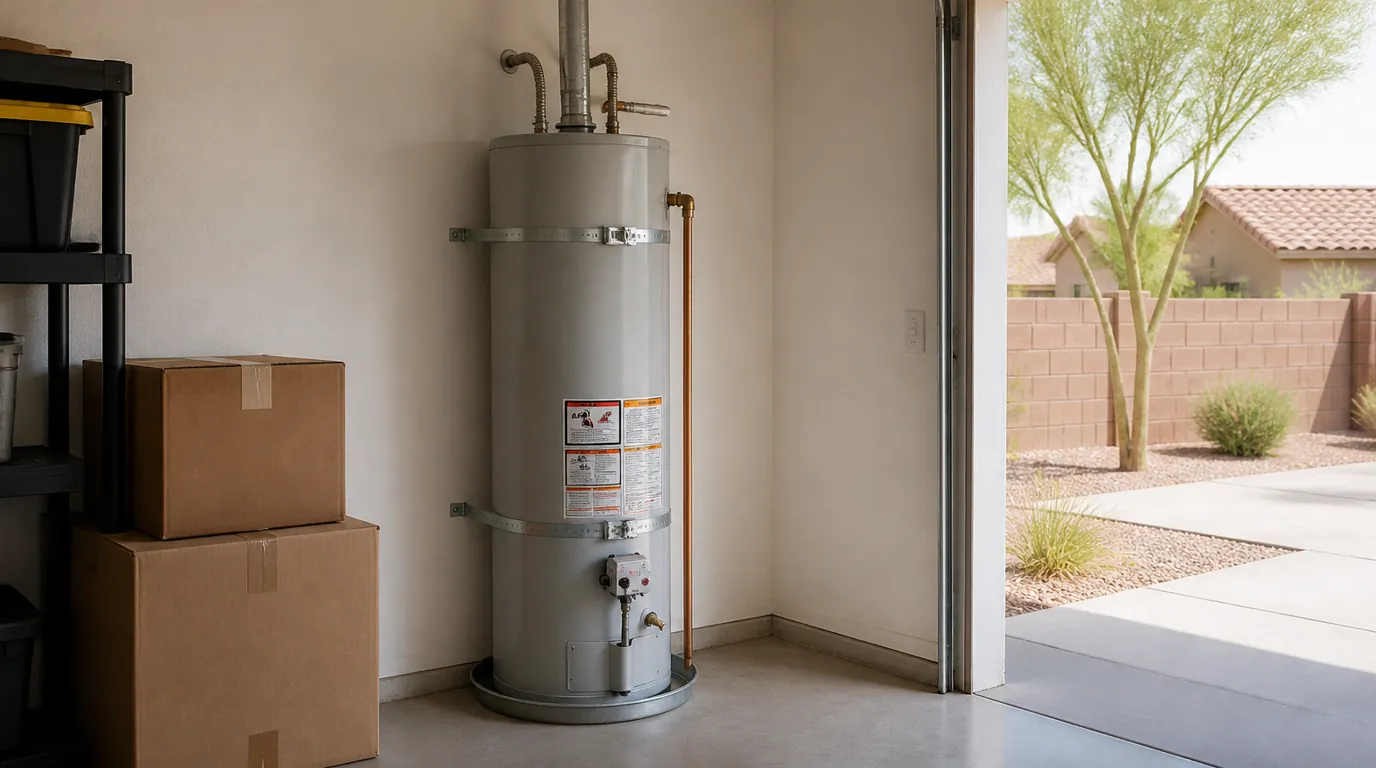
Shut the cold supply valve on the pipe above the tank, then turn the thermostat down or switch off the breaker on an electric unit. For a gas unit, set the gas control to pilot or off.
Do not touch wet wiring. If the floor is flooding, shut off the main water valve for the house.
Look at the top of the tank for loose pipe connections that drip down the side. Check the temperature and pressure relief valve and its discharge pipe. Look at the drain valve near the bottom.
Condensation can also form on a gas unit or on cold pipes in humid weather, though in the desert that is less common. Dry the area and see if the wet spot returns.
Loose connections, a dripping drain valve and a failing relief valve can usually be repaired without replacing the tank. A plumber tightens, replaces or reseals the part.
If the relief valve discharges often, the cause may be high pressure or high temperature. That needs a proper diagnosis and not just a new valve.
If water seeps from the bottom of the shell or from under the insulation, the inner tank has failed. Rust and mineral buildup eat through the steel over time.
A leaking tank body cannot be repaired. Plan a replacement and ask about water heater replacement options.
Use the location of the wet spot as your first clue.
| Source | What it suggests | Usual next step |
|---|---|---|
| Pipe fittings on top | A loose or worn connection | Shut off, then repair the fitting |
| Relief valve discharge pipe | High pressure or temperature, or a failing valve | Check pressure and replace the valve |
| Drain valve at the bottom | A worn valve | Replace the valve |
| Tank shell or under the insulation | A failed inner tank | Plan a replacement |
Hard water deposits scale on the tank floor and the heating elements. Sediment traps heat and stresses the steel. Flushing helps, and a softener slows the buildup.
Garage tanks also bake in summer heat, which wears down controls and insulation.
A drain pan with a pipe to the outside gives you an early warning and a place for small leaks to go. A leak sensor on the floor can send an alert.
If the area stayed wet, dry it quickly with fans. Wet insulation and drywall can grow mold in a couple of days.
Rust streaks down the side of the tank point to a slow leak from a fitting above. A pool of water with no streaks may point to the tank bottom. Mineral crust on a fitting shows a long-term drip.
Look at the label for the age. Most tanks have a date code in the serial number. A tank past ten years is more likely to be failing than a young one.
On a gas unit, never relight the pilot if the tank is leaking. Water near the burner can put it out and cause problems. Turn the control to pilot or off and call a plumber.
On an electric unit, the breaker is your first stop. Elements sit inside the tank, and a leak near the element access panel can short wiring. Treat any wet panel as a hazard and keep clear until power is off.
The temperature and pressure relief valve guards the tank against excess heat or pressure. When it opens, water flows down the discharge pipe. A few drips after a heating cycle can be normal, but a steady stream is a warning.
Never cap the discharge pipe. If the valve drips often, a plumber measures pressure with a gauge and may add an expansion tank.
If you plan to keep the tank, draining a few gallons from the bottom valve helps move sediment out. Hard water makes this more important. Do it only with the power or gas off and the cold supply closed.
Do not try to flush a tank that is already leaking from the shell. It will not fix the problem and can make a mess.
A new tank costs more than a repair, but a failed tank leaves no choice. Plan for the size, fuel type and venting. Ask whether permits and a drain pan are included, and ask about a tankless unit if you want to compare.
Read tankless water heater service if you are weighing a change.
Call if water is pooling, if the leak comes from the tank body or if you are unsure of the source. Describe the tank age, fuel type and what you have shut off.
See water heater repair for what a visit covers.
It can be, because water near wiring or a gas burner is hazardous. Turn off the power or gas and the water supply, then phone.
Better not. A small leak can grow and damage the floor. Shut it down and get it checked.
If water comes from the shell or under the insulation and not from a fitting, the tank has probably failed.
Some policies cover sudden leaks but not wear. Ask your insurer.
Many tanks last around ten years, depending on water and care.
Yes. Turn off power or gas and the cold water supply.
Work out why a tank leaks, rumbles, runs lukewarm or loses its pilot flame.
Retire a worn tank and pick a size, fuel type and spot that suit the house.
Dry and rebuild floors and walls after a leak, a burst pipe or flooding.
Know where the shutoff is before a pipe bursts. Learn the two valves, which way to turn them and how to test that they hold.
White crust on faucets and short-lived heaters are signs of hard water. Learn what scale does and how to deal with it.
A bang in the walls when a tap shuts is water hammer. The cause is often pressure or a loose pipe, and the fixes are simple.
Shut off the water and power or gas, then call. You will be put through to a plumber who can help.
Service area centered on Avondale and nearby Maricopa County cities.