Commercial Plumbing
Service for stores, offices, kitchens and distribution buildings, from floor drains to lift pumps.
A backflow preventer keeps irrigation water, pool water and other contaminants from flowing backward into the drinking supply. Devices need periodic testing, and failed ones need repair or replacement.
Check any notice from the water provider. It lists the device location and the deadline for the test.
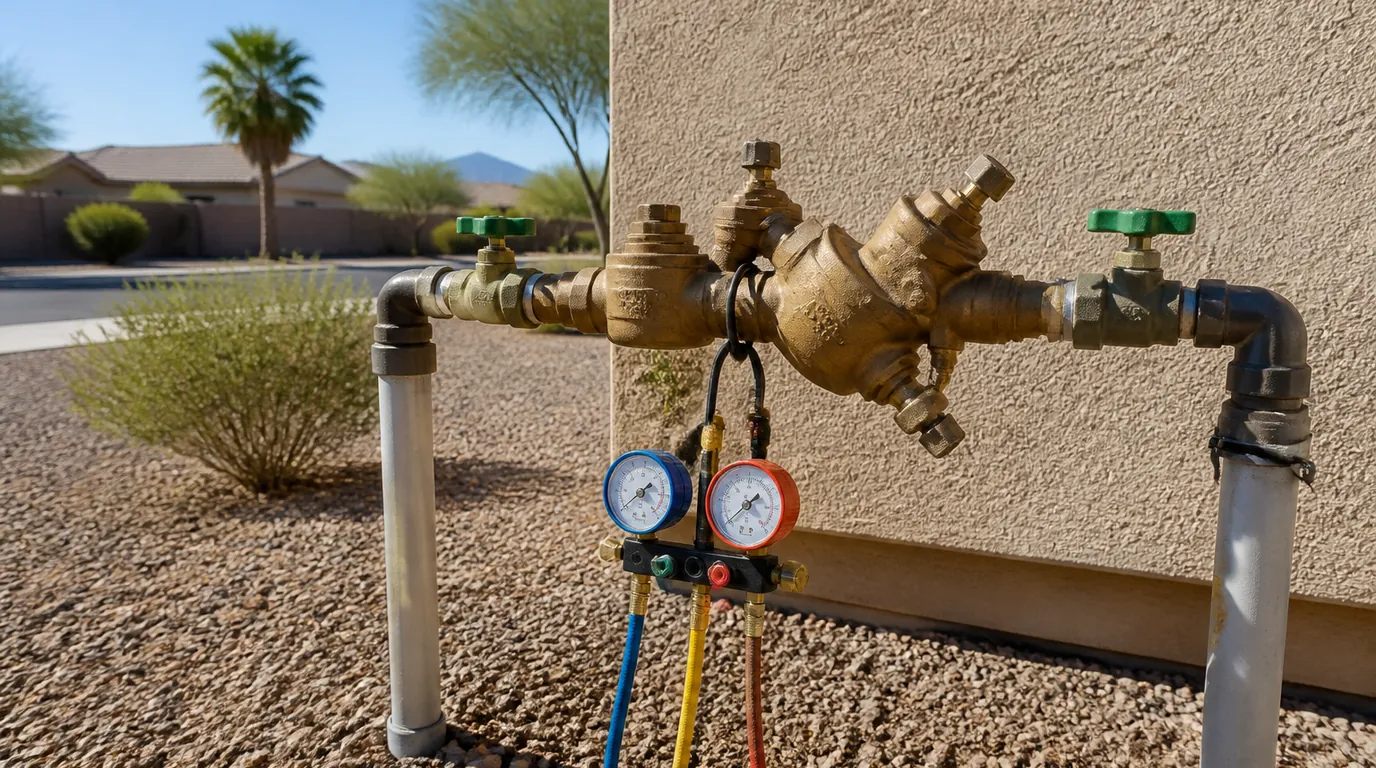
If pressure in the supply drops, water can flow backward from a lawn sprinkler, pool fill line or commercial process. That could pull contaminants into the drinking water.
A backflow preventer is the valve assembly that blocks it.
Residential irrigation systems often have a vacuum breaker or a pressure type assembly near the main. Businesses may have larger reduced pressure or double check assemblies on fire lines and process equipment.
Pool fill lines and some water features may also need protection.
Many Avondale yards use irrigation, so a backflow device is common. If you receive a notice from your water provider, follow its instructions for testing.
For City of Avondale accounts, Public Works at (623) 333-4400 can answer questions about requirements.
Cost depends on the device and what the test finds.
Ask whether the test report is submitted for you.
Testing is done by a certified tester using a gauge kit to measure the device's check valves and relief valve. The result goes on a report that the water provider may require.
Ask the contractor whether they hold the certification the provider accepts, and who submits the report.
Failed devices are often fixed by replacing internal parts. A device that is cracked, frozen or obsolete is replaced.
Installation needs correct height and clearance, so a device that sits in a low pit may need relocation.
These suggest the device needs attention.
Locate the device and clear brush and rocks around it. Have the provider notice handy.
Photograph the device and read the label for brand and size.
The tester connects a gauge to test ports and checks each check valve and the relief valve. They record the readings and tell you whether it passes.
If it fails, they quote the repair.
A failed seal or spring is a simple repair. A damaged body is replaced.
See commercial plumbing for larger assemblies.
Keep each test report with the date, the device serial number and the tester's name. A record of passing tests helps if the provider asks, and it shows when a device is due for replacement.
If a device fails twice in a few years, consider replacing it instead of repairing it again. Ask the contractor to compare repair parts with a new assembly.
Service for stores, offices, kitchens and distribution buildings, from floor drains to lift pumps.
Repair or replace the underground line that feeds water into the house.
Underground, rough-in and trim plumbing for new builds, additions and remodels.
Usually once a year, but the water provider sets the rule. Check your notice.
The plumber repairs or replaces it and retests it.
Ask the contractor. Many submit it for you.
Many irrigation and pool systems have them. Rules vary by provider.
Cost depends on the device size and type. Ask for a quote before the visit.
Ask the dispatcher about scheduling, especially if you have a deadline.
Tell the dispatcher the device type and size.
Ask the dispatcher. Water is shut off briefly during the test.
Yes. The dispatch line is answered around the clock. Describe the device and what you noticed, such as water discharging from a relief port, and the dispatcher will explain the next step.
Call and mention the notice from your water provider. The dispatcher will connect you with a plumber.
Service area centered on Avondale and nearby Maricopa County cities.